
Arthur Brain
Date of birth: 16.6.1885
Date of death: 19.7.1917
Area: Normanton
Regiment: King's Own Yorkshire Light Infantry
Family information: Husband of Evelyn nee Fletcher
Rank: Corporal
Service number: 240574
War Service
Arthur was already a member of the Territorial Army before war broke out. When war was declared he enlisted at Normanton and was assigned to the 1/5th Battalion, King’s Own Yorkshire Light Infantry and he was one of the first to be sent to fight.
In August 1914, Arthur’s battalion, the 1/5th Battalion, was stationed at French Gate, Doncaster as part of the 3rd West Riding Brigade of the West Riding Division. They moved from Doncaster to Gainsborough and then in February 1915 to York. After training was completed, Arthur and his unit embarked for France, landing in Boulogne in April 1915.
In May 1915, the battalion became part of the 148th Brigade of the 49th Division. At the start of the “Battle of the Somme” on the 1 July 1916, Arthur and his battalion were in reserve in Aveluy Wood and Thiepval Wood. During the 4-6 July Arthur was in the front line in Thiepval Wood, then Leipzig Salient, Aveluy Wood Sector. Early September, they were again in the front line in Thiepval Sector and mid November the Hebuterne area.
During the winter months Arthur would have experienced atrocious conditions whilst in the trenches, enduring artillery and sniper fire. Entries in the battalion diaries mention heavy snow, frost, wind and rain. Late winter and early spring of 1917 saw Arthur and the battalion rotate with a few days in billets at Riez Bailleul and in the line at Neuve Chapelle.
Entry in the battalion diary:
1-4 June 1917: “enemy bombarded Neuve Chapelle 1 sector “B” Coy on the left subject to heavy bombardment also Lieutenant Bennett and Corporal Brain of that company did very good work holding the men well in hand and digging out three men from blown in shelter.”
For his action, during this time, Arthur won the Distinguished Conduct Medal.
During the 4-12 June 1917, the battalion practised for a proposed raid on enemy trenches.
The official report of the action of 12/13 June 1917 confirms the battalion was involved in a raid on the German lines under heavy German bombardment. With the help of returning British artillery fire, the men went over the top, moving over No-Man’s-Land towards the German front line. They found the German outer defence barbed wire cut in a number of places, allowing some of Arthur’s comrades to access the German trenches.
Hand to hand combat must have ensued. Official report of the raid indicates a number of Germans killed with bullets and bayonets.
A letter dated 15 June 1917 from the Brigadier General commanding the 148th Infantry Brigade, congratulates Lt Colonel Moxon C.M.G. the commanding officer of the 1/5 King’s Own Yorkshire Light Infantry Battalion and all ranks for “gallant and successful enterprise carried out by the whole battalion on the night of the 12/13 June 1917 under exceptional difficult conditions.” He then goes on to say “It is more noteworthy because, at the time of the operation, the battalion had been continuously in the trenches for a period of over six months.”
A week later on the night of 21/22 June 1917 another raid took place in the same area near Neuve Chapelle. Again, Arthur’s comrades gained access to the German trenches, with similar results and hand-to-hand fighting.
Entry in battalion diary states:
“29 Germans known to be killed, 2 prisoners taken. The battalion casualties were 2 officers wounded, 1 man killed, 1 man missing, 38 men wounded.”
On 24 June the battalion left the line departing to Foss. On the 17 July 1917 the battalion moved back into the line in the Lombartzyde sector at Nieupoort. After a relatively quiet period of training and a well-earned rest and reorganisation, they were soon to come under fire again.
Entries in battalion diary for 18 July state:
“very heavy casualties were sustained during a hostile heavy bombardment.”
Presumably it was during this bombardment Arthur was mortally wounded.
A report in the Wakefield Express dated 21 July 1917:
“ALTOFTS CORPORAL’S GALLANTRY RECOGNISE
Mrs Brain of 27 George Street, Lee Brigg, Altofts has this week received from her husband, Corporal A. Brain of the K.O.Y.L.I., an illuminated card which had been sent to him by Major-General Commanding the 49th (West Riding) Division, congratulating him upon the way he distinguished himself in the field on June 4th inst., as reported by his Commanding Officer and Brigade Commander. A friend of the Corporal’s, writing home to Altofts friends, states that he has been awarded the D.C.M. but this has not been confirmed as yet.”
A report in the Wakefield Express dated 28 July 1917:
“THE TRAGEDY OF AN ALTOFTS HERO
Last week we mentioned that a report had been received in Altofts, that Corpl. A. Brain of the K.O.Y.L.I., whose home was at 27 George Street, Lee Brigg, had won the D.C.M. and this week, whilst we have the pleasure of recording that this has been confirmed, we have the sad duty to perform of recording his death in action. The official notification of this distressing fact was received within a very short time of the happier message announcing his receipt of the military distinction and it has caused widespread sympathy with the widow throughout the township. The decoration was awarded to the gallant corporal, who had always been a fearless soldier and shown a splendid example to his comrades on more than one occasion when they had been in tight corners, for the way in which he kept his men under control during a German raid upon our trenches, and also for his daring and initiative in rescuing three men who had been buried alive. As to his death, his widow has received a letter from the Rev. J. Tully, a chaplain at one of the Casualty Clearing Stations stating that he was admitted to the hospital on the morning of July 19th suffering from severe wounds in the head. He was unconscious and passed away during the day without ever regaining consciousness.
The chaplain very sympathetically alludes to the soldier’s internment in a military cemetery and sends a touching message of condolence to the sorrowing widow.”
The citation dated 16 August 1917:
“240574 Cpl. A. Brain. D.C.M. King’s Own Yorkshire Light Infantry
Awarded the Distinguished Conduct Medal
For conspicuous gallantry and devotion to duty.
During an intense bombardment of our front lines, he displayed the greatest coolness and courage in patrolling his trench and holding the men together in readiness to meet an enemy raid. Assisted by his platoon commander he also dug out and saved the lives of three men who had been buried by the bombardment. He set a splendid example to all ranks during a very trying time.”
The following appeared in the Roll of Honour printed in the Wakefield Express 28 July 1917:
“BRAIN - In loving memory of Corporal Arthur Brain, aged 31, D.C.M. K.O.Y.L.I. of Altofts, the beloved husband of Evelyn Brain and eldest son of John Brain, who died of wounds received in action. Buried at Adinkerke Cemetery, France.
Fold him, O Father in Thine arms
And let him henceforth be
A messenger of love between
Our human hearts and Thee
From his sorrowing Wife and Children.
BRAIN – In loving memory of Corpl. Arthur Brain, D.C.M. K.O.Y.L.I., died of wounds July 20th, aged 31, eldest son of John Brain, Locke’s Row, Altofts
“Peace, perfect peace” – from Father and family.
BRAIN – In loving memory of my loving son-in-law, Corpl. Arthur Brain, D.C.M., K.O.Y.L.I. of Altofts.
“Man’s inhumanity to man makes countless thousands mourn”
- From the Fletcher family at home and abroad.”
A notice appeared in the Wakefield Express – it reads:
“BRAIN – In memory of Corpl. Arthur Brain, D.C.M., aged 31, the beloved husband of Evelyn Brain, George Street, Altofts, who died of his wounds July 19th, 1917. Buried at Adinkirke Military Cemetery on that day. “Only those who have lost can understand”.
From his loving Wife and Children.”
Arthur now rests in peace in Adinkerke Churchyard. The village of Adinkerke is close to the border with France, approximately 13 miles from Dunkirk. The Churchyard Extension is a Military Cemetery. Unfortunately, 100 years of coastal weather has caused some erosion of the inscription on Arthur’s headstone. All official documents confirm Arthur died on 19 July 1917 although 10 July appears to be engraved on the headstone.
Family Life
Arthur was born in Altofts on the 16 June 1885, the fourth child of John and Mary Jane Brain. Like so many people in the mid 1800’s John and Mary Jane moved to Yorkshire from the Midlands to seek work in the Yorkshire coalfield. John found work as a lampman at one of the local collieries. During Arthur’s childhood he lived with his parents and siblings in Locks Row, Altofts. After leaving school he followed his father to a local colliery working as a pony driver.
Arthur’s mother died in 1901 when he was 15 years old. At the age of 24 years Arthur married Evelyn Fletcher of Wakefield in 1909. They soon became parents, first Ivor then Arthur junior, followed by Richard and Ashton. In 1911 Arthur and his family lived at Hill Top Farm, Altofts and Arthur was now working in the mine at the coalface as a hewer. Arthur certainly was a man of many talents and contradictions. He was a trained pianist, often called upon to play at Lee Brigg Working Men’s Club and at Altofts Methodist Chapel. He was a trained blacksmith/farrier and also engaged in bare-knuckle boxing.
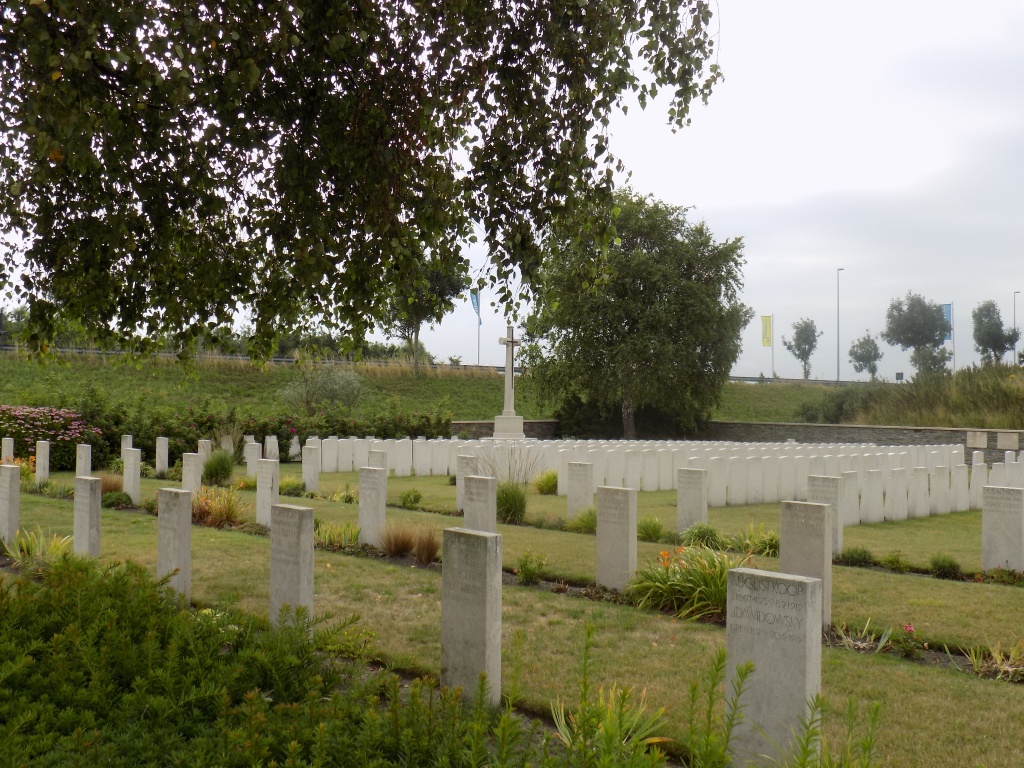 Adinkerke Military Cemetery